What is a barricade?
A broken door leans against a beer barrel. An abandoned truck straddles a motorway. Everyday items are hurriedly selected and then swiftly repurposed, jammed together in a loose conglomeration of forms that jut out at peculiar angles. This is a barricade. These strange, improvised sculptures would not look out of place in a modern art gallery. They take the familiar objects of everyday life and turn them into something more unusual. A barricade is a collage. A bricolage. It is a scrap heap with meaning. “You can paint with whatever you like,” wrote the experimental poet and art critic Guillaume Apollinaire in 1913. “Pipes, postage stamps, postcards, playing cards, candelabras, pieces of oil cloth, shirt collars, wallpaper or newspapers.” We might then add: an upturned cart, a fence, a bike, a tent. “People have referred to an Italian artist who painted with faeces; during the French Revolution someone painted with blood.” Like many of the artists who came after him, Apollinaire believed that everything that makes up the modern world could be repurposed for art: “catalogues, posters, advertisements of all sorts.” In defending cubism and surrealism – both terms that he had a hand in popularising – Apollinaire became one of the leading proponents of collage as an artistic practise. He was interested in the beauty of fragments juxtaposed. And what is a barricade if not a heap of fragments? A physical manifestation of two juxtaposing ideas? It is as if the normal world is breaking down, being torn apart and reassembled right in front of us. It is the city defending itself.
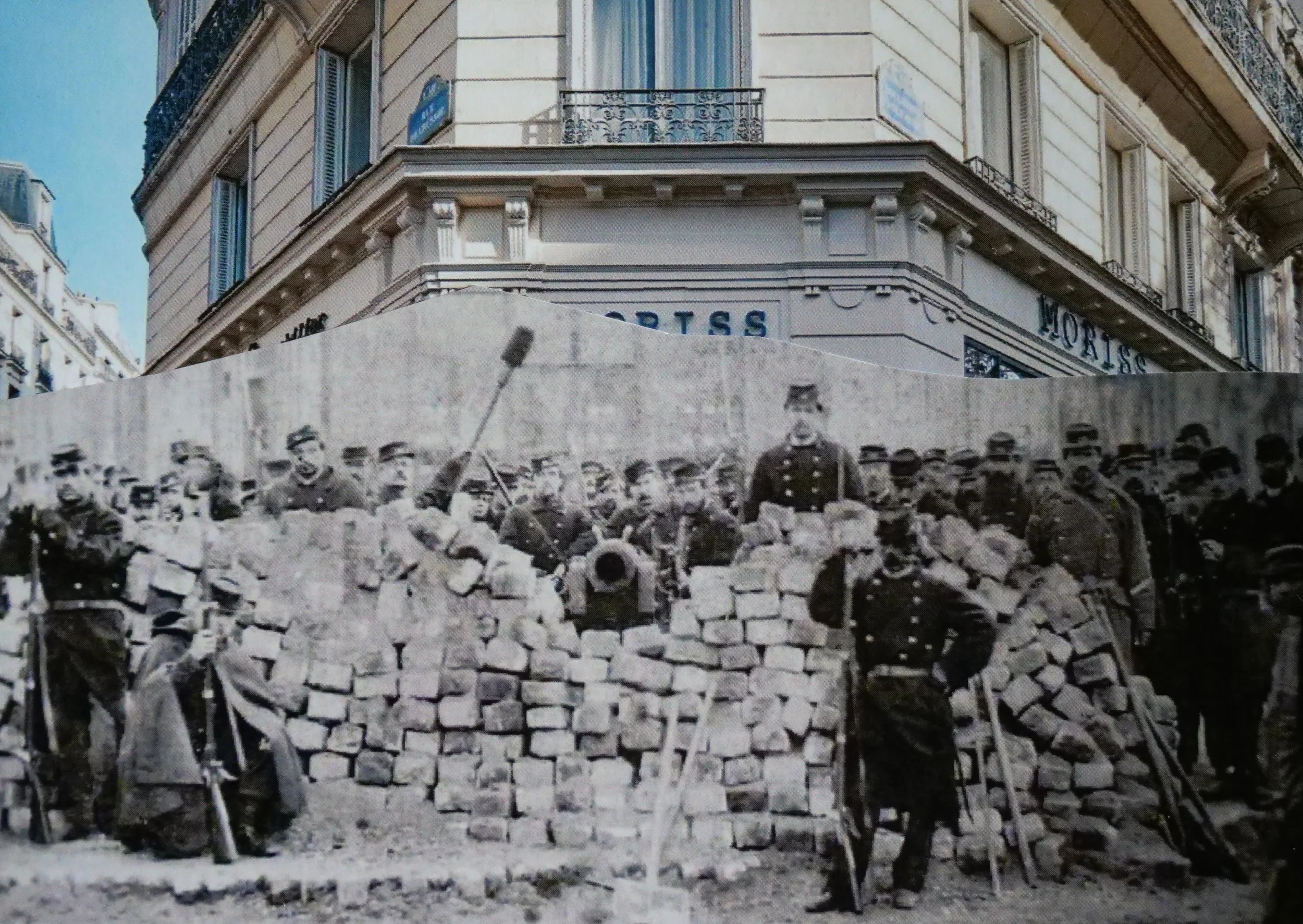
Barricades are the work of many hands. They form a network that links communities in struggle and block the powerful from gaining entry. At their most effective, a series of barricades can turn a city into a dangerous maze, confounding the enemy and isolating their troops. They are a defence, of course, to hide behind. But they are also a stage, a platform from which to inspire, to tease, to insult, to persuade. Historic accounts often mention the routine “haranguing” of soldiers; some soldiers are sometimes convinced to defect. During the July Revolution of 1830, entire regiments defected or laid down their arms. “The women and children came and mixed with the troops,” wrote one general later that century. “We were greatly mistaken in permitting these people to approach our soldiers, for they mingled among them, and the women and children told them: ‘You will not fire upon the people’”. Many of these barricades were built by women, and they often stayed to defend their creations. During the Paris Commune of 1871, women built impromptu barricades to prevent troops from moving cannons. In Bloody Week, they fought on the barricades. “It is time that the old world came to an end!”, wrote Elisabeth Dmitrieff. “If the arms and bayonets are all being used by our brothers, we will use paving stones to crush the traitors.” For these women, the barricades were a site of struggle, yes. But they were also a space of possibility. Of things being different.
Whilst reading Les Chants de Maldoror, the French surrealist André Breton stumbled upon a sentence that became foundational to how surrealists thought about juxtaposition: “as beautiful as the chance encounter of a sewing machine and an umbrella on an operating table.” His friend Max Ernst explained it as the “linking of two realities that by all appearances have nothing to link them”. But, for me, this explanation seems to leave out the comedy. There is something of the carnivalesque about collage. Picasso’s experimental sculptures; Dada’s cut and pasted illustrations; Hausmann’s mechanical head; Duchamp’s readymades; Man Ray’s indestructible objects; Schwitters’ Merz; Miro’s parrot; Brauner’s fox; Cornell’s wooden boxes; Rauschenberg’s combine-paintings. These collages provoke smiles and stifled laughter. The bringing together of disparate objects creates a kind of ironic tension that forces us to look again at what is already in front of us. A sewing machine? An umbrella? An operating table? Yes. And perhaps all at once.
The construction of a barricade brings together various objects that produce a similar effect. Our usual route through the city is disrupted. We are forced to stop, to look again, to grapple with a new material reality. In 1827, another short-lived rebellion saw groups of workers and students build barricades in Paris. After a couple of hours they were demolished by armed police, but the young people were able to rebuild them almost immediately. No sooner had one been destroyed than two more had sprung up in its place. This performance played out again and again. A contemporary account described “laughter and shouts of encouragement from the crowd of spectators, who were amused by the sight of such novel scenes.” Even a badly organised barricade can outwit the powerful. Street fighting stalls armies and forces soldiers to dismount. Guerilla warfare gets people killed. But, worst of all, it makes the invaders look silly.
Over a hundred years later, rebellious students were still causing chaos on the streets of Paris. The writer Daniel Singer later described the barricades of 1968 as appealing “to the collective memory of the French workers, whose grandfathers had fought in the Commune.” Kristin Ross agrees. “The students understood the barricade as not only a practical defense but a symbolic link to the revolutions of 1830 and 1848 — moments when Paris became the heart of revolutionary Europe.” These barricades were symbols of intent, the tools of political storytellers. “Barricades close the street but open the way”, ran one popular slogan. It was important to these students to be surrounded by the symbols of their collective endeavour. As the media maniacally denounced them, the barricades reminded them of their purpose. So too did the graffiti scrawled on the walls and the posters plastered around the streets of the Latin Quarter. Students quickly established a studio - the “Popular Studio” or “Atelier populaire” - for printing posters in support of their movement. They churned out hundreds of pieces carrying encouraging slogans: “The revolution is incredible because it is real”, “Poetry is in the street”, “Culture is the inversion of life”, “Power to the imagination”, “Let us ban all applause, the spectacle is everywhere.” Some of these slogans were then plastered onto the barricades.
Covered in slogans, the barricades of Paris had been transformed into billboards for the revolution. “In all its specific forms, as information or propaganda, advertisement or direct consumption of entertainments, the spectacle is the present model of socially dominant life”, wrote Guy Debord one year previous. “The spectacle does not sing the praises of men and their weapons, but of commodities and their passions.” Some of the participants in May 1968 have since worried that they were doing nothing more than performing dissent, reproducing the symbols of revolution with none of the radicalism. “May 1968 had nothing revolutionary about it: only the imagination of it”, said Daniel Cohn-Bendit, a student who became an icon of the uprising and in later life a Green politician in the European Parliament. “Only a minority of those who made ‘68 dreamed of a revolution.” As Cohn-Bendit tries to distance himself from his more radical past, he is being slightly unfair to his old comrades; the students might have been naive in their tactics, but the uprising transformed the Left in Europe and caused ripples of dissent across the Western world. Made possible by the barricades around them, their protests had opened up a utopian space into which progressives projected their desires. Their dreams of revolution.
What does it mean to build a barricade today? It is true that, with every repetition, the barricade became less and less a tool of insurrection and more and more a symbol, a message, a backdrop for a press conference. Daniel J Boorstin in ‘The Image’ defined a “psuedo-event” as an event that is not spontaneous, is designed to be reported, is intended to be a self-fulfilling prophecy, and has an ambiguous relationship to the underlying reality of the situation. As radical activity moved away from insurrections and the militant street fighting of previous centuries and towards modes of peaceful protest and the modern day social movement, more protests fulfilled Boorstin’s criteria of the “psudeo-event”. Activists became adept at sending press releases, choreographing photocalls, designing their movements so as to attract maximum attention. The historian Dennis Bos argued that the barricade ironically became ubiquitous at the same time as it became tactically useless. “The barricade referred to an imaginary world of socialist chivalry,” he writes. “In many accounts the symbolic barricade functioned as a stage for acts of bravery or as the background for scenes of proletarian martyrdom.”
Thankfully, revolutionaries have always innovated. In 1868, Auguste Blanqui wrote ‘Instructions for an Armed Uprising’. Blanqui had been hit by a bullet as a student whilst constructing a barricade in the failed uprising of 1827; the wound was superficial and his mother patched it up for him. But his brush with death left a mark. “Enough of these tumultuous uprisings, with ten thousand isolated individuals, acting haphazardly, in disarray”, he wrote. “Enough of these ill-conceived and ill-placed barricades that waste time, block the streets and prevent movement.” Blanqui argued that barricades must be built more purposefully, more strategically if a modern revolution was to succeed. Determined to avoid the mistakes of the past, he provided exact calculations for how many paving stones were needed per barricade and how exactly to go about constructing them.
Ironically, the old Blanqui missed out on the chance to implement his plans during the Paris Commune of 1871. Despite being elected president of the commune in absentia and enjoying vociferous support from many of its key figures - including Louise Michel, Raoul Rigault, and Edouard Valliant - the man himself spent the entire period in a prison cell in Versailles. At one point, the Communards offered to release all of their prisoners if the Thiers government released Blanqui, but their offer was refused; Theirs told his allies that “to turn over Blanqui to the insurrection would be to provide it with a force equal to an army corps”. But Blanqui was a sick, 65 year-old man. He might have been less effective at building barricades than the government thought. “A revolution improvises more ideas in one day than the previous thirty years were able to wrest from the brains of a thousand thinkers”, wrote Blanqui in 1852. “Let us destroy the old society – we shall find the new one beneath the ruins.” The students of 1968 might have been thinking of him when they invented a similar slogan: “beneath the paving stones - the beach!”
So, is a barricade a piece of art? Somebody who might have thought so is Napoléon Gaillard, the director general of the barricades during the Paris Commune. Before the commune, Gaillard was a shoemaker. “The Art of the Shoe,” he wrote later in life, “is, no matter what one says, of all the arts the most difficult, the most useful, and above all the least understood.” If shoemaking was art, then so too was barricade building. Gaillard spent many days completing one of his masterpieces, a barricade nicknamed “Château Gaillard.” This elaborate construction reached a height of two stories; it was finished with bastions, gable steps, and a facade flanked by two pavilions. “He considers the barricades that he has constructed as both works of art and luxury”, ranted one contemporary, “he only speaks of them with a love and admiration that he transfers back, obviously, onto his own person.”
The depiction of Gaillard as a maverick artist has been exaggerated by historians on all sides; they have variously depicted him as a romantic figure with lofty ideas about the aesthetic power of resistance and as a vain braggard who typified the problems of the Paris Commune. But the real Gaillard was more practical. He constructed a number of barricades that helped in the defence of the city. Indeed, his work was noticed and commended. On 30th April 1871, Gaillard was given a promotion and commanded a special battalion of barricaders. He was tasked with building a system of barricades forming an enclosure in the centre of Paris, in addition to three other enclosures at the Trocadéro, the Buttes Montmartre and the Panthéon. Gaillard did so. Slowly perhaps, but beautifully.
Despite this extensive preparation, however, Gaillard’s large barricades were easily overcome. Some accused him of vanity. If he had approached the task with more seriousness, they argued, then perhaps they would have fared better. But the Communards were outmanoeuvred on all fronts, more totally and more decisively than can be blamed on one man. The large streets of Paris, remodelled by Haussmann to make barricade building trickier, proved hard to defend and the Versailles troops would rarely attack the barricades head on anyway; instead, they climbed to the top of adjacent houses and shot down from above. It might be convenient to blame Gaillard and his artistic sensibility, but it seems absurd to suggest that he was responsible for their crushing defeat. Instead, contemporary critiques of the Paris Commune tend to emphasise a lack of leadership. They argue that the Communards should have marched on Versailles immediately, or at the very least taken over the Bank of France instead of merely asking for a loan. They write with a ferocity that modern socialists would never dare. “The commune, once elected, busied itself with passing laws and decrees, most of which were not implemented”, wrote Jean Grave, “Revolutionaries! That's nevertheless what they thought they were, but only in words and parades.” Ernest Daudet concurred, describing “the men of the Hotel de Ville clinging to their stage, and continuing to decree and decree amid all the din of the wind and the tempest.”
The barricades had become a stage once again but, now, only for death. And sadly there was plenty of it. For such an important historical moment, only a few paintings of the Paris Commune have ever been completed; most depict the events of Bloody Week, the final massacre. Once the Versailles troops broke into Paris, they were indiscriminate in their violence. “People of Montmartre, you may think me a cruel man”, shouted Gaston Gallifet, the Versailles commander. “You’re going to find out that I am much crueller than even you imagined!” One contemporary pointed out that these soldiers acted in the manner they had been trained abroad, furthering French colonialism: “After having spent years setting fire to Algerian villages and massacring the tribespeople, the soldiers were well trained in spilling blood in our cities.” By the end of the week, thousands of bodies were tossed into mass graves. Many more were deliberately left in the streets, rotting amidst the rubble of the barricades. This is the image of the barricades that the Versailles government want us to remember. Death. Blood. The cost of their defiance.
During the two months of the Paris Commune, the communards cycled through three Delegates of War. The first was mistakenly accused of being a traitor; the second resigned after a couple of days; the last, Charles Delescluze, was an aging revolutionary with no military experience. Delescluze was also dying of consumption. He signed proclamations with a shaky hand and could hardly speak due to laryngitis. When the enemy broke through the city walls, Delescluze refused to believe it. As his comrades were massacred, he sat at a table on Boulevard Voltaire. He calmly wrote out a couple of orders and rattled off a few final letters. “Everything is finished for me”, he wrote to a friend. He then walked unarmed to the nearest barricade, climbed on top of it, and waited for death. A bullet killed Charles Delescluze almost instantly and his slumped body lay on the barricade for days. A tragic image. Still, what is a barricade if not a heap of fragments? As the bodies piled up, so too did the barricades. More scrap, more junk, more material for sculpture. The painter and critic Fairfield Porter once wrote of assemblage: “sculpture, using junk, is a creation of life out of death, the new life being of a quite different nature than the old one that was decaying on the junk pile, on the sidewalk, in the used-car lot.” In a similar way, the Communards gave up their lives for a new idea. A new way of being. “In its decay there is already a new beginning,” wrote Porter.
If the barricade is now primarily a symbol, then it means different things to different people. For the rich and the powerful, it is something to be feared. It is a portent of death. But, for socialists, the barricades of the Paris Commune - however weak they ultimately proved - are a symbol of something far more hopeful. Something new and vital. “The Paris Commune was something more and something other than an uprising”, wrote the communard and anarchist Arthur Arnould. “It was the advent of a principle, the affirmation of a politics. It was a new revolution, carrying in the folds of its flag a wholly original and characteristic programme”. Why did the Communards concentrate so much on proclamations and ideas at a time of war? I suspect at least part of the reason is that this was a new project, a break with the past so decisive that it required explanation. Previous revolutions ushered in a new elite, but the Paris Commune was the first to elect predominantly working class representatives. For this reason, the historian Eugene Schulkind has called it “the first modern revolution.” And, as Marx once intimated, the single greatest achievement of this modern revolution was “its own working existence.” Could it be that had the Communards spent less time on outlining their project - on articulating their politics through proclamations and decree - and more time on military tactics, their story would have been a lot less compelling? If it were just another failed insurrection, would its symbol be so potent today? Might we be less interested without the stories of the soup kitchens they established, the cooperatives they built, the unions they started?
“Behind the barricade there may be much that is noble and heroic”, wrote Oscar Wilde. “But what is there behind the leading-article but prejudice, stupidity, cant, and twaddle?” Despite its manifold failures, I am still drawn to the proclamations. To the ideas that the Paris Commune unleashed upon the world. It continues to amaze me that a group of proletarians were able to form a new government and achieve so much in so little time. The Communards ended evictions, stopped the collection of overdue bills, introduced a minimum wage, turned over abandoned businesses to the workers, set up workshops for the unemployed, abolished night work in bakeries, ended child labour, made education free and compulsory, approved schools for boys and girls, and paid men and women the same wage. Female Communards set up a union for women; they provided aid for soldiers, fought on the front lines, sent staff to orphanages, cared for old people, recruited nurses and canteen workers. In return, the commune gave them funds and priority over government contracts. “It was a new revolution because it was a workers’ revolution”, wrote the communard and Marxist Leo Frankel. “For us, March 18th signals the dawn of a new world, of a new society.” Sure, their barricades were grandiose and rubbish. But the ideas behind the barricades lived on.
The rich and powerful have their own monuments, their own art. After the Paris Commune, the Theirs government continued the Haussmannisation of Paris with its wide boulevards and its military shortcuts; Haussmann called himself a “demolition artist”. They built the Sacré-Cœur, an imposing religious building that still looms large over the city, and left the burnt-out shell of the Tuileries Palace standing for twelve years after the fall of the commune. The art world changed too. The art historian T. J. Clark has argued that avant-garde painting began with the modernisation of Paris: “It seems that only when the city has been systemically occupied by the bourgeoisie, and made quite ruthlessly to represent the class’s rule, can it be taken by painters to be an appropriate and purely visual subject for their art.” Albert Boime in his study of art after the Paris Commune added, “the Impressionists – moderate republicans – descended into the public sphere to reclaim symbolically its sullied turf for the bourgeoisie.” This included Manet and Morisot. “I had come out of the siege absolutely disgusted with my fellow man, even with my best friends”, wrote Morisot. During the revolution, the painter and pacifist Gustave Courbet had established a new federation of artists. “Art should not lag behind the revolution that is taking place”, he exclaimed. “Paris is a true paradise!” Courbet set about protecting art and drawing up plans for a new art salon run by artists; he also - famously - pulled down the Vendôme Column. But after the commune, Courbet was suddenly out of favour. Despite purporting to share many of the same values, Manet distanced himself from Courbet during the commune. Afterward, he seemed to regain some of his radical reputation; he ranted about the events of Bloody Week and accused Courbet of behaving like a coward. Poor Courbet couldn’t do anything right. But his style, so influential to Impressionism, was harder to banish. After mistakenly believing that Courbet had been murdered, Claude Monet later visited his friend in prison. Throughout his life, Monet returned to many of the same places as Courbet, painting many of the same landscapes around Étretat in Normandy. “It is terribly audacious on my part to do that after Courbet did it so admirably,” wrote Monet, “but I will try to do it differently.”
Spurred on by Courbet, the Impressionist break from the traditions of the past arguably paved the way for more radical departures in the art world. Their exploration of modern life and their rejection of idealised subjects were both vital developments to the work of the conceptual artists that followed. Sebastian Smee argues that the Impressionists were “a kind of spiritual salve”, offering respite from the events of the commune; they “recoiled from the delusional ravings of men, whether of the left or the right.” If this is true, so be it. But the attempts by the rich and the powerful to bury the barricades have failed. In politics and in art, the symbol of the revolution endures. “If I have a regret, it’s not dying in battle or at a barricade as I’ve always romantically imagined”, wrote Mike Davis towards the end of his life. One of his readers replied: “I’m glad that you did not die on the barricades too soon, before we had your wonderful books. After all, aren’t they a kind of a barricade for the ages?” And yet the best barricades are still functional; they waste time, protect activists, outwit the authorities. But they also tell a story. They excite, delight, foster a community. When Extinction Rebellion blocked Oxford Circus with a big pink boat in 2019 it was not a declaration of war. It captivated the imagination, it grabbed headlines. Protesters, of course, became incredibly attached to it. “Defend the boat!”, they would cry as the police approached. But what were they defending? A story? A news item? Another day of discourse? I do not ask these questions in order to mock anyone. In a society so obsessed with the spectacle, such things are often worth being arrested over. I too was arrested for gluing myself to the doors of a fossil fuel conference. Why? The press line goes: “to send a message.” To send a message. But are we merely sending messages, or are we serious about building more radical alternatives? If a barricade is a symbol, then can’t it also be useful?
Last year, student encampments at American universities sprung up in support of Palestine. Many of them used makeshift barricades to separate themselves from the police. In Britain, we blocked the entrance ways to arms factories with banners, cars, lock-ons, and often our own bodies. In the Arab Spring, many of the barricades that were built used crowd-control fences and other police equipment. The master’s tools to dismantle the master’s house. Protest architecture is itself a growing field; plywood boxes, inflatable cobble stones, bamboo beacons. The barricade continues to transform, to fall apart and reassemble itself. As the police learn to deal with one form of barricade, another is invented. So, what is a barricade? In the nineteenth century, it was a tool of war. Strong, heroic, sweeping - like the art that dominated. In the twentieth century, it became symbolic. Fragmented, referential, a part of the spectacle - like Dada, Surrealism, Cubism, Fluxus. Today, it appears almost mythical. But few, it seems, are willing to reach into the earth and begin building a proper barricade. A barricade made of stones, and mud, and the scraps of everyday life. When they do, we marvel. It is as if the Communards are back, heroes from a golden past. “To the barricades!”, they cry. “Yes, to the barricades!” Because a barricade is many things but, ultimately, it is a call - one we all instinctively understand - to action.