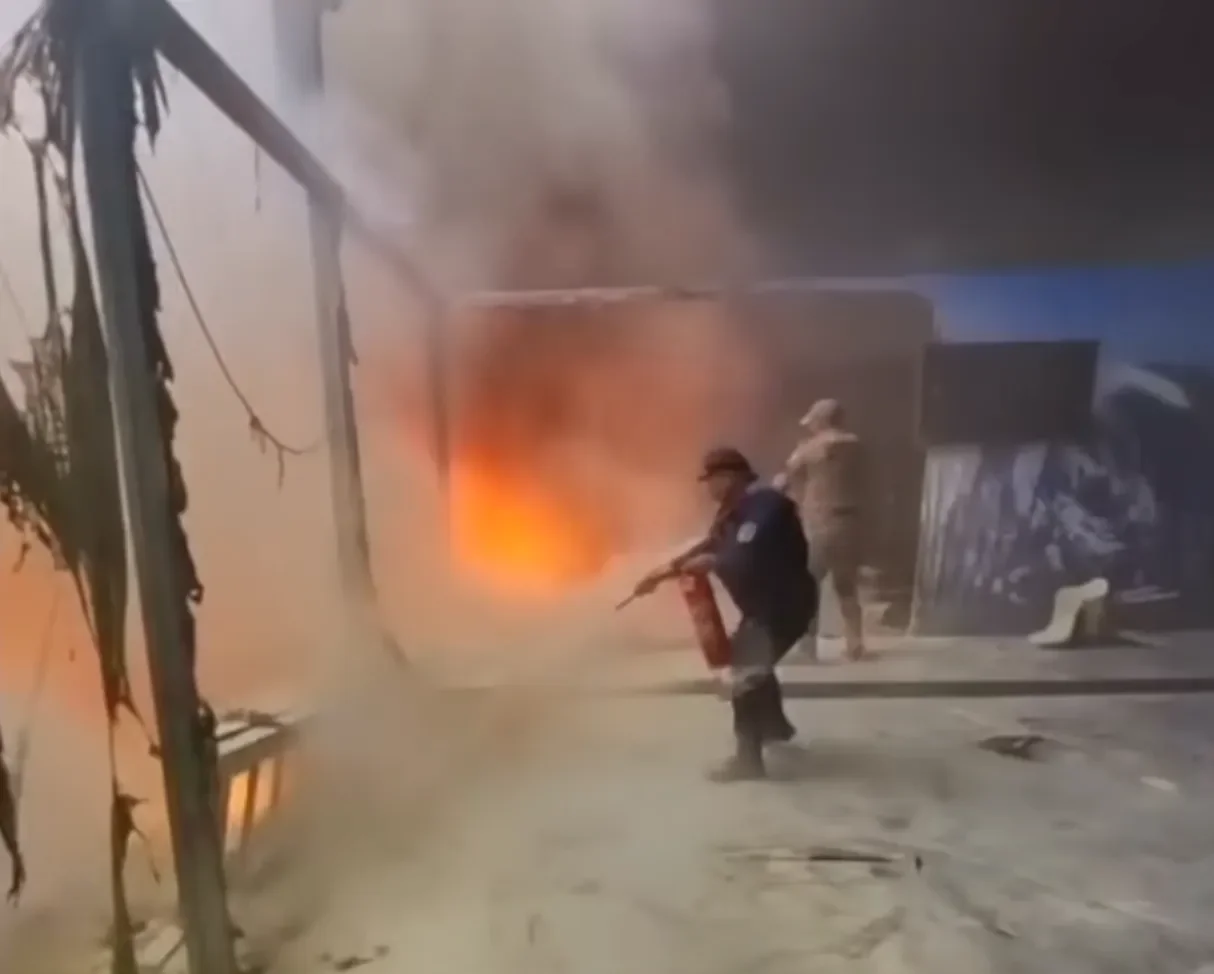
FIre, Fire!
“Prophecies are so back”, wrote one social media user. “The Old World has awakened”, wrote another. Somewhere in southern Spain, an amateur photographer had captured an image of a white Iberian lynx. In the photograph, it sits poised, staring at the camera with large, penetrating eyes. The photographer uploaded the image to his Instagram account where it soon went viral. He called it a “white ghost of the Mediterranean forest.” Others called it a “divine omen”, a “harbinger of things to come”, “something almost mythical.” Encounters with these extraordinary animals are rare enough, but the white fur of this particular creature is a total aberration. Against the dull earth, it looks otherworldly. Like an old, lost god.
The internet forgets quickly. Within a couple of hours, whatever message this strange creature was meant to impart had been easily forgotten. To be honest, nobody had thought much about what it meant anyway, just that it was the sort of thing that should have meant something. Amid the meaninglessness of social media that is nothing to be sniffed at, but it is not enough to sustain any prolonged interrogation. Had we been living a couple of hundred years ago, this obvious symbol – this divine visitation – might have been taken a little more seriously. Instead, it was immediately reduced to the status of a meme. Brought down by a cowardly, self-conscious irony.
Our disenchanted world takes moments of sublime beauty, of symbolic truth, and spits them out again as dispiriting spectacle. And yet, as climate and ecological breakdown continues apace, such strangeness permeates the contemporary. Birds fall from the sky. Beasts run through the streets. Rare creatures wash up on sunny beaches. If you are looking for them, the warnings are everywhere. How long can we continue to ignore these signs? Even the most ordinary encounters with nature suddenly feel weirder, more urgent and more symbolic. Were we to look properly at everything happening now, from the wildfires ripping through the tundra to the flood water lapping at the door, wouldn’t we notice a thousand, flashing warnings?
A white Iberian lynx is not the only portent of doom to have been unleashed upon the world in the last month. Last week, there was a fire at COP30, the UN Climate Change Conference in Brazil. As a sign, it is pretty on-the-nose. “Fire, fire!” Someone screamed, as they ran through the conference centre. A couple of the delegates rolled their eyes. Another laughed. Everyone initially assumed that this was just another protest. A clunky metaphor about the end of the world. “Fire, fire!” Suddenly, a thick cloud of smoke appeared over the pavilion walls. There really was a fire, and now everyone was running from it. Screaming, panicked. Heads of state, fossil fuel lobbyists, charity workers, journalists. Thousands of delegates streamed out of the building and into the pouring rain.
Had they been looking for the warning signs, they might have predicted it. The conference centre was built in a hurry, constructed with cheap materials that were not designed to last. When delegates arrived, the walls were still being painted. There were no fire alarms and not enough fire hydrants. Within days, the toilets were blocked and the runways had flooded. Navigating the venue was a nightmare. Nearby, a new highway cutting through the Amazon rainforest was also being constructed. When Indigenous tribes protested, they were ignored. Early on in the talks, Indigenous peoples occupied the venue carrying signs that read: “our forests are not for sale”. A couple of days later, they blocked all the entrances and exits; the COP President was forced to come out and talk to them, finally agreeing to address their concerns. But little actually changed and the warnings were once again left unheeded. At the start of the talks, a Māori woman had addressed the conference. “Listening to the voices of Indigenous peoples is like listening to the voices of the forest and the birds”, she had said. “The last remaining divine source.” Chief Raoni Metuktire gave one final prophecy: “If we continue destroying everything on this earth, there will be many consequences, there will be chaos on this earth.”
Luckily, nobody was injured in the fire. A handful of people were treated for smoke inhalation. The Culture and Entertainment pavilion went up in flames. An afternoon of negotiations was lost and a couple of events had to be rescheduled at the last moment. But it could have been a whole lot worse. The entire episode had been dramatic, sure, and yet everything was still salvageable. Forgettable, in fact. The fire, it turned out, was more symbolic than it was tragic. It operated on the level of a metaphor – immediately translated into parable from the moment it took light.
The climate crisis has always had this problem. It is the ultimate allegory. It is, in fact, distinctly literary, bound up as it is in narratives of greed, revenge, rupture, and repair. Step back and ponder the current moment. The ordering systems by which we structure our society – most prominently, capitalism and colonialism – have convinced us that we are no longer a part of nature and that all life is in service to capitalist accumulation. As a result, we have overexploited the Earth ruthlessly and the most terrifying horrors have been unleashed. Poisonous rivers. Deadly plagues. Wildfires the size of skyscrapers. Wouldn’t a medieval soothsayer transported to the present conclude, quite reasonably, that the end times are now upon us? Wouldn’t any pre-Enlightenment peasant know how to read the tea leaves of the twenty-first century better than most of us?
There is, after all, a sort of neatness to the climate story. Crisis creates story, and what is climate change but the ultimate crisis, and therefore the ultimate story? Even in its unevenness, in its targeting of those least responsible for the crisis, there is a sort of cosmic irony at play – a literary explanation at the heart of it. But that climate change is so obviously already a story has barely troubled writers and artists. A satisfying narrative that follows a clear, dramatic logic is all well and good, but what if it is in fact too powerful, too captivating a story to be integrated into another form? Does it not consume everything it shares a page with? Is it not too ready-made, too pre-packaged? Strangely, most thinkers of the last decade have concluded the exact opposite. In 2011, Rob Nixon claimed that the climate crisis “resists spectacle” and instead encounters a series of “formidable representational obstacles” on account of its slowness. In 2013, Timothy Morton categorised the climate crisis as a “hyperobject” which withdraws from direct representation despite structuring everything. The climate story must be told over geological epochs, they said, and meanwhile our experiences of breakdown are too small, too slow, and too displaced. But what if climate change resists being turned into metaphor not because it is too big or too slow, but because it is already metaphorical? Because it already operates according to a clear narrative logic?
Most people ignored the fire at COP30. Some of my friends were at the conference and I texted them, worried about their safety. One replied: “My friends alerted everyone but it burnt down.” Another replied: “Am safe thanks, actually in a very boring meeting.” One of my friends, a veteran of the talks, was speaking at an event when the fire started. As the conference centre was hurriedly evacuated, she found herself flung together with some of her old colleagues. The last time they had all been together was whilst negotiating the Paris Climate Agreement. Now, they helped one another through the chaos, out of the venue, and into the rain. They agreed to get on the first bus out of there, riding it to the very end of the line where the bus depot was and the bus driver lived. An hour later, the rain lifted and they found themselves at the riverside. They walked down to an empty cafe on the bank of the river and watched the sunset. Surrounded by the beauty of the natural world, they talked, and laughed, and danced. “It was magical”, she said, “it felt like Mother Nature had led us there.”
What happens when you don’t allow an event like this to move you? In literature, unheeded warnings soon lead to damnation. Cassandra is perhaps the archetypal example of this in Greek mythology, an oracle destined to proffer true prophecies but who is never listened to nor believed. Then there is Oedipus, who it is foretold will murder his father and marry his mother; his parents attempt to frustrate the prophecy by abandoning their son to die but, in doing so, unwittingly ensure its fulfilment. The same dynamics are played out in the Norse myths, the Hindu epics, Chinese folklore, Arthurian legend. In Shakespearean tragedy, Macbeth misinterprets the witches and Julius Caesar ignores the soothsayer, both leading to their own untimely death. So, why do so many characters in our most ancient stories ignore prophecies? Well, in narrative terms it is to reveal the moral. To show the repercussions of their actions. It is not satisfying for Greta Thunberg to simply warn: “act as if your house is on fire.” For us to sit up and to take notice, the house needs to burst into flames.
This is the story logic we must break. The images that spring to mind when I think about climate change today are eminently representable. They are like modern day fairytales, drowning in symbolism. Terrifyingly huge, of course, but on the scale of an epic poem. More mythic than modern. And the Right recognise this too; the climate fiction, as they see it, is just that, a fiction. It is too convenient, too simple, too easily reduced to conspiracy. So if we are going to take the climate crisis seriously, to act upon the warnings as they appear, then we are going to have to learn both how to read them as stories and how to take them as facts. The fire must be metaphorical and it must be real at the same time.
A few decades ago, the Iberian lynx was on the brink of extinction but recently the population has rebounded; in has been moved from “endangered” to “vulnerable” on the official list of threatened species. And yet the lynx that broke the internet is still unique. Its ash white fur is still remarkable. “It’s neither albinism nor leucism,” Javier Salcedo says, a project coordinator who has been working to reintroduce these animals into the wild. “We think it could be exposure to something environmental.” Here, logic and myth are not incompatible. Both can explain the current moment. And, in responding to the climate crisis, it seems to me that we urgently need both.