A kind of persiflage
In 1963, a group of German artists coined the phrase “Kapitalistischer Realismus”, or “capitalist realism”, for an art exhibition in Dusseldorf. Three of these four artists had fled East Germany before the building of the Berlin Wall. Their emergent style – a style that they called German Pop Art – traversed feelings of both allure and alienation, reacting against the socialist realism of the Soviet Union whilst capturing a sense of communal unease within the apparent alternative. They were fascinated – inspired, even – by the strangeness of everyday life under capitalism. They produced blurred paintings, fake advertisements, strange happenings in unusual places. One exhibition was in an empty butcher’s shop, another in a department store. The latter ended with several pieces of furniture being damaged and the owner of the store threatening to call the police. “I don’t think it is quite right that it has become so famous”, reflected one of the artists many years later. “It was just a lot of fun.”
Their next exhibition – a blatant act of self-promotion – was in the gardens of an influential art dealer. Uninvited, they drove to his private villa and hung their paintings among the trees. “This exhibition is not a commercial undertaking,” the artists wrote in one press release, “and no gallery, museum, or public exhibiting body would have been a suitable venue.” The art dealer, however, was flattered. He offered them space in an established gallery and the group changed their mind about the suitability of such spaces. No more butcher’s shops or department stores. So, had they sold out? Not exactly. “For me, Kapitalistischer Realismus was quite simply a brand,” said the curator René Block, “not a style, not an ideology.” Block would later play a key role in defining this short-lived movement, displaying their artwork together and keeping the concept of “capitalist realism” alive. According to him, these artists were not engaged in a radical political project. They did not seek to dismantle capitalism, they sought only to mock it. To poke fun at it. “It was a mirror of petit bourgeois behaviour,” he said, “but more as a kind of persiflage than an attack.”
Gerhard Richter was one of the four artists who created “Kapitalistischer Realismus” alongside Sigmar Polke, Wolf Vostell, and Konrad Lueg. He is still a celebrated artist and his work continues to set records at auction. During the financial crisis of 2008, one of the original “capitalist realism” paintings was sold to a Swiss businessman – currently serving a prison sentence for environmental damage and voluntary manslaughter in Italy – for £7,300,500. “It’s just as absurd as the banking crisis”, said Richter a couple of years later, “it’s impossible to understand.” For an artist who is so often interpreted politically, Richter has always been uncomfortable about discussing politics in public. “I don’t really believe that art has power”, he says. He insists his work is about beauty, coincidence, solace, spirituality even. “I am creating a picture, not an ideology.” But then, in the next breath, he criticises Angela Merkel for welcoming so many refugees to Germany and moans about political correctness. He is a strange artist, like his paintings. An exercise in blurring the edges, of avoiding simple interpretation. “There is no such thing as capitalist realism”, he said recently, “it made Socialist Realism appear ridiculous, and did the same to the possibility of Capitalist Realism as well.”
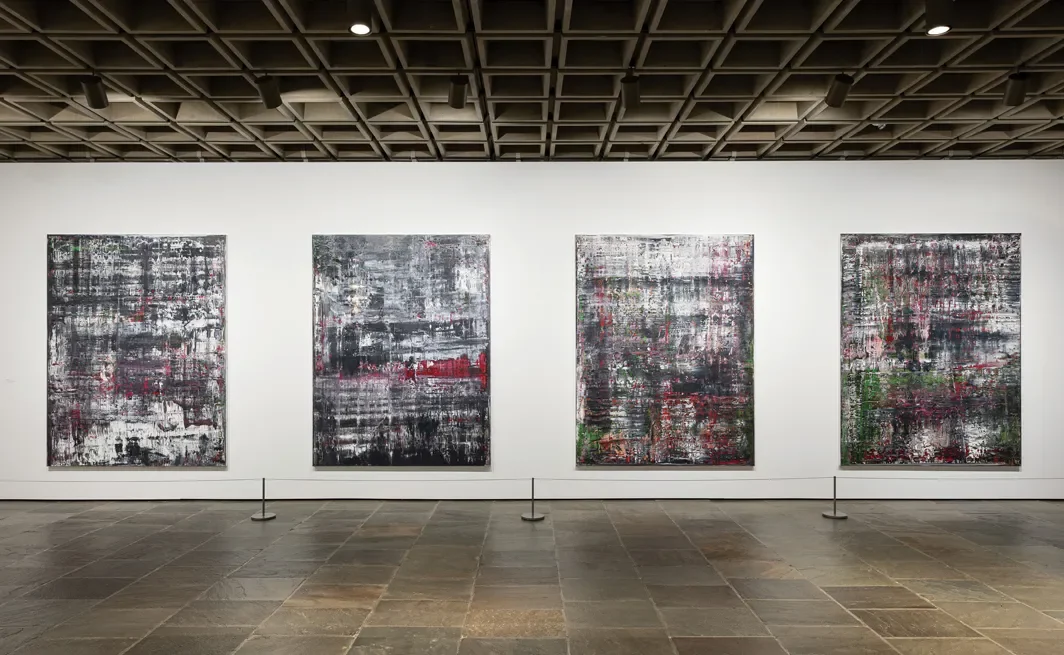
Caught between two ideologies, Richter chose to reject them both – instead, he embraced the third way of postmodernity. Richter was also one of the first German artists to address the Holocaust directly in art, creating distorted paintings of family members who had been members of the Nazi Party and others who had been their victims. In a cycle of paintings entitled Birkenau, Richter paints over photographs taken by an inmate of the infamous concentration camp, depicting the burning bodies of Jews in a forest and naked women on their way to the gas chamber. They are strangely muted paintings. Distorted, yet startling. Michael Brenson once wrote that Richter is an artist preoccupied with “painting the unpaintable”. And he wasn’t the only one. After the catastrophe of the Holocaust, there was an expectation from the rest of the world that German artists would acknowledge this profound tragedy in their work. Many younger artists agreed; they believed that there was a culture of silence in Germany and it was their responsibility to interrogate it, to expose it, to crack it open. But the old forms which had been co-opted by the Nazi party were no longer a solid starting point. These younger artists were therefore compelled to experiment, to invent new ways of making.
Others rejected the idea of art after the Holocaust entirely. In an essay that has too often been taken out of its proper context, Adorno is famous for having written, “To write poetry after Auschwitz is barbaric.” He was writing against a culture, and particularly against a form of cultural criticism, that reinforced the barbarity rather than rejected it. But, nonetheless, many took him to mean that to write poetry after Auschwitz was immoral, impossible even. Richter was one of the artists who rejected this premise entirely. “There is lyric poetry after Auschwitz”, he insisted. Adorno agreed, writing: “I have no wish to soften the saying that to write lyric poetry after Auschwitz is barbaric; it expresses in negative form the impulse which inspires committed literature.” He had meant it as a challenge, not a statement of fact. And challenging it was. Richter had tried to create similar paintings of Auschwitz in the 1960s, but abandoned the project. Later in his life, however, Adorno offered a reappraisal: “it may have been wrong to say that after Auschwitz you could no longer write poems”, he now wrote, “but it is not wrong to raise the less cultural question whether after Auschwitz you can go on living.” Perhaps that is why his previous statement has proved so ineluctable. Genocide has a halting effect. It crushes the imagination, extinguishes hope. After such barbarity, people often reach for words like “unimaginable”, “indescribable”, “unthinkable”, and – in the case of the art world – “unpaintable”. We want to feel somehow that our art understands this. We want to see the ruptures, stand over the broken fragments. Catastrophe fractures culture, and through these cracks new forms begin to emerge.
It is sometimes difficult to imagine a world beyond catastrophe, beyond crisis, beyond the most violent of cataclysms. “Kapitalistischer Realismus” was a failed attempt to do exactly that. It fizzled out. The group disbanded. And the term “capitalist realism” was buried, only occasionally used in advertising or in the art world before it was resuscitated many decades later. Writing in the wake of the global financial crisis, Mark Fisher defined capitalist realism as “the widespread sense that not only is capitalism the only viable political and economic system, but also that it is now impossible even to imagine a coherent alternative to it.” Fisher took an art term and applied it to contemporary film, then protest movements, and then to society as a whole. He argued that this feeling structured our understanding of politics and culture in the twenty-first century. “Capitalist realism as I understand it cannot be confined to art or to the quasi-propagandistic way in which advertising functions,” he wrote. “It is more like a pervasive atmosphere, conditioning not only the production of culture but also the regulation of work and education, and acting as a kind of invisible barrier constraining thought and action.” It is, like most of his work, an alluring and exciting idea. Like the art movement that came before it, it is also rather broadly drawn. A deliberately slippery thing.
Regardless, “capitalist realism” became a watchword for the left. It was how those of us who grew up during the financial crash came to understand the world. The term became ubiquitous, and so too did those who championed it, challenged it, redefined it, or declared it over. Kai Heron, in a recent article entitled Capitalist catastrophism and eco-apartheid, argues that our era, that others have sometimes called the “anthropocene” or the “capitalocene”, is now characterised by a dramatic and asymmetric reconfiguration of the capitalist world system. The neoliberal project is clearly in freefall. Shock after shock. Crisis after crisis. It frays, it snaps, it breaks. According to Heron, a system of eco-apartheid has replaced the neoliberal order. As the imperial core returns to an explicit strategy of social and ecological plunder, a programme of neofuedalism has become the dominant mode of Western capitalism. Heron thinks of this new regime as supplanting – mutating, unmaking – an era defined by Mark Fisher’s theory of capitalist realism. “Unless there is a radical break from capitalism what will supplant capitalist realism is not the ability to imagine and fight for a post-capitalist future,” he writes, “but something more ambiguous and perhaps ultimately worse.”
For Heron, “capitalist catastrophism” describes a situation in which capitalism can no longer determine what it means to be “realistic”, not because of the force of movements assembled against it but because capital’s self-undermining and ecologically destructive dynamics have outstripped state and capital’s powers to control them. “Under capitalist catastrophism we no longer need to imagine the end of the world”, Heron writes, “we watch it in real time, we read about it on our social media feeds, and we take to the streets to protest it.” Many have pronounced the end of “capitalist realism”, “late stage capitalism”, “postmodernism”, or any of the various terms used to describe our current epoch, and been unable to point towards what comes next. But Heron is not heralding a new era, he is grappling with the collapse of our current one. “Capitalist catastrophism is what happens when capitalist realism begins to fray at the edges,” he writes. This is a culture borne of breakdown. A society built on collapse. Heron argues that capitalist catastrophism is not a coherent social formation, it is instead “the prolonged unmaking of one.” But what does it mean to live in an era defined by unmaking? What art is made in the interregnum?
Amitav Ghosh, in a recent lecture entitled Intimations of Apocalypse: Catastrophist and Gradualist Imaginings of the Planetary Future, seems trapped between a vision of climate justice which he sees as slower and “fundamentally a question of governance” and a vision of climate breakdown that is something darker and apocalyptic. In an attempt to synthesise the two, Ghosh speaks of apocalypse happening gradually and more perniciously than some in the West would have us believe. “Catastrophist imaginings of the planetary crisis have permeated deep into contemporary culture”, he says, but this catastrophist imaginary has largely been shaped by the concerns of elites. Ghosh argues that the way in which poorer people in the Global South conceptualise catastrophe and the way in which rich people in the Global North conceptualise catastrophe is incompatible. One rests on apocalypse, surprise, bloodshed, and cataclysm. The other is more adaptive, practised, regenerative. Likewise, Heron talks of the future being cancelled for some people and not for others. A cultural understanding of catastrophe and the politics required to overcome it that are fundamentally opposed. In terms of economic power, we might assume that the colonial culture dominates and subjugates the other. But, for Ghosh, it is the capitalist understanding of catastrophe that is weakest. “Affluent countries are in many ways more vulnerable to the climate crisis”, he argues, “I suspect the febrile imaginings of apocalypse that are now so commonplace in the West are the result of living in societies that are unable to deliver on their promises.” Our story is unravelling. The grand narratives of capitalist societies – from the absurdity of trickle down economics to the false promise of infinite growth – are becoming less and less credible in the face of climate breakdown. A catastrophist story now threatens to replace them.
Ghosh has done much to sketch out a new aesthetics in his book The Great Derangement: Climate Change and the Unthinkable. And there it is again: the unimaginable, the indescribable, the unthinkable. Catastrophe calls out to the impossible. “I suspect that human beings were generally catastrophists at heart until their instinctive awareness of the earth’s unpredictability was gradually supplanted by a belief in uniformitarianism,” Ghosh writes. Like those who said there could be no lyric poetry after Auschwitz, Ghosh contends that there can be no literature as usual after climate change. The contemporary novel, he argues, is unable to comprehend our current predicament. And realism, a literary style that aspires towards an affected approximation of reality, is unable to contain the “unreality” of the world we now inhabit. I have written elsewhere about my disagreements with some of his conclusions, but Ghosh is an artist asking all the right questions. “What is it about climate change that the mention of it should lead to banishment from the preserves of serious fiction?”, he asks. “And what does this tell us about culture writ large and its patterns of evasion?” As the effects of climate breakdown become unavoidable and inescapable, no longer unthinkable or unimaginable, the other extreme appears. For decades, a culture of silence permeated modern society. Today, climate change is everywhere and catastrophe has become the dominant cultural mode. In 2021, Verso published The Anthropocene Unconscious: Climate Catastrophe Culture by Mark Bould. Whereas Ghosh once argued that culture conceals catastrophe, Bould now believes that “the art and literature of our time is pregnant with catastrophe, with weather and water, wildness and weirdness.”
Catastrophe is indeed everywhere. As Walter Benjamin wrote, “The concept of progress must be grounded in the idea of catastrophe. That things are ‘status quo’ is the catastrophe.” This understanding of catastrophe is aligned with Adorno’s hope that art is able to reveal a permanent and universal catastrophe that defines modern society after the Holocaust: “One speaks of the threat of a relapse into barbarism. But it is not a threat— Auschwitz was this relapse, and barbarism continues as long as the fundamental conditions that favoured that relapse continue largely unchanged.” But what does this catastrophism look like? For Ghosh, the catastrophist imaginary as it manifests in the Global North is dominated by fantasies of escape, retreat, war, and the apocalypse. He reels off a now familiar list for those of us interested in the climate pessimism of the capitalist class: survival bunkers, private islands, fights over resources, colonies on Mars. The end times. A capitalist fever dream. This is an imaginary built on scarcity, and it conceals a fatal scarcity of the imagination. At its root, capitalist catastrophism is an exercise in ignoring the reality of climate breakdown, and avoiding the redistributive policies that are required to overcome it.
In the catastrophist imaginary, climate breakdown is usually taken to be inevitable. In fact, the shortest version of this story happens in the blink of an eye; the apocalypse brings with it fire and brimstone. Everyone dies, the world ends. Further thought is deemed unnecessary. But the extended version of this story is a little less absurd: wars rage, famine spreads, democracies crumble. In the rightwing imaginary, this is usually figured as a race war: marauding armies from the Global South come to steal the land and the resources of the Global North. In the liberal imaginary, these wars are translated into confrontations between global superpowers, with China or Russia squaring off against the United States and the European Union. But all these future wars avoid the real war needed to address climate breakdown: class war from below. The catastrophist imaginary rarely affords agency to the working class or the dispossessed; they are figured only as victims. If capitalist catastrophism is about escape or retreat, it begs the question: who is able to escape? Here, the working class are presented as obstacles: uncontrollable servants, wily thieves, faceless mobs. So long as the catastrophist story is told from the perspective of capital, we will all remain stuck in a crushing paralysis. A cultural doom loop.
As Jessica Mulvogue has noted in her study Catastrophe Aesthetics, the word “catastrophe” was used in the sixteenth century to mean the denouement in a play or, “the change or revolution which produces the conclusion or final event of a dramatic piece.” It was a word originally associated with theatre, with tragedy, with the subversion of order. But it also provided a final turn, akin to the volta in poetry. The catastrophe reordered everything that we as audience members once took for granted. This is still a key aspect of catastrophe today, overturning and reordering our understanding of time and space. Nothing is the same after catastrophe, nor should it be. If capitalist realism tries to conceal reality, catastrophe attempts to crack it open. For Mulvogue, art is helpful in the struggle for climate justice as a site of possibility, rather than as a site of action. It makes thinkable the previously unthinkable and spurs on the utopian impulse. She quotes Kim Stanley Robinson: “the future is a kind of attenuating peninsula; as we move out on it, one side drops off to catastrophe; the other side, nowhere near as steep, moves down into various kinds of utopian futures.” A familiar binary now appears that structures so much of the catastrophist left imaginary. Socialism or barbarism. Survival or death. “We have come to a moment of utopia or catastrophe; there is no middle ground.” Now, Mulvogue goes one step further. She argues that we are no longer at the crossroads, no longer stood atop the peninsula. No, no, no. We have already entered the catastrophic.
The imaginative power of catastrophe is often presented as an antidote to the ills of capitalist realism. But is it enough? Kai Heron argues that our culture is no longer constrained by an inability to imagine the end of capitalism. His points towards a revival of the radical imagination, an explosion over the last few years of post-capitalist imaginaries. Heron reels off a number of different futures: Green New Deals, degrowth futures, eco-modernist utopias, small farm futures. But these futures still seem distant, limited, unrealised. Is imagination as an antidote to capitalist realism beginning to ring hollow? We can be fierce advocates of an imaginative, playful, populist form of politics but without a theory of revolution, without putting in the hard graft of building real power in the here and now, utopian socialism is no more than a bourgeois parlour game. “What we lack under capitalist catastrophism is a theory and a practice of transition that breaks with our habituated patterns of thought and practice to bridge the gap between the present and the future”, Heron writes. It is hard to disagree. Deep down, most people now understand that capitalism is unsustainable. But we also know that replacing it with a more sustainable system will require a confrontation with wealth and power on a global scale. Persuading people that such a confrontation is possible, not just necessary, is the most important challenge of our age. The climate crisis is a question of strategy, of power, of possibility. That should be the question that now preoccupies us. But is it? If capitalist realism defined an age in which our shared problem was an inability to imagine a world after capitalism, capitalist catastrophism is instead constrained by our inability to imagine a pathway out of it. It’s a progress of a sort, I suppose.
Amitav Ghosh once wrote about what he called the “Great Derangement”, the idea that climate change had become unthinkable in contemporary literature. But today climate change is eminently thinkable, so thinkable it has become catastrophic. So, what is the silence that now permeates our culture when everything else is so loud and ruinous? Perhaps it is the same silence that has always characterised postmodernity: revolution, strategy, class struggle. These concepts are an anathema to the privately educated gatekeepers of maisntream culture. And so too is the utopian imaginary, the Green New Deals and the degrowth futures. When Heron heralds a new age of imaginative renewal, he is thinking of ideas that have generally come out of activist spaces and universities. But these ideas are not yet evident in our dominant culture. Why? Mark Fisher grappled with the same question when he was writing Capitalist Realism. “But what of the catastrophe itself?”, he asks, “How long can a culture persist without the new? What happens if the young are no longer capable of producing surprises?” It is the same question that also fascinated Gerhard Richter and the other artists who created “Kapitalistischer Realismus”. Their answer was a form of German pop art that skimmed over the surface of the political, that avoided grand narratives and poked fun at capitalism. But if capitalist catastrophism is a new phase of capitalist development, then why is it seemingly so impotent? Is the era of capitalist realism over, or is it more intense and suffocating than ever before?
These days, art seems to lag behind. If we are living through an age of imaginative renewal it has yet to assert itself through the dominant culture. In response to the populist turn of the past decade, the political establishment has sought to shrink the window of acceptable thought ever further. The same has happened to an even greater degree in the cultural industries. The highest grossing film last year was a feature-length advert for a toy company. The best selling book was written by a member of the royal family. Entertainment companies and art dealers are making more money than ever before, but only the super rich can afford to be artists. Gone are the days when you could survive on unemployment benefit whilst writing your first novel. This isn’t just bad for us, it’s bad for mainstream culture too; capitalism has historically stolen and co-opted new art movements to slick the wheels of its own cultural reproduction. This is what Guy Debord calls “recuperation” in The Society of the Spectacle, the tactic by which capitalism neutralises its opponents. The Situationists were so scared of recuperation that they ultimately vowed to become more inaccessible; “the more famous our theses become, the more shadowy our presence will be.” But it is impossible to retreat to the shadows when nothing casts much of a shadow. Today, we are stuck. There are no new art movements. There are no challengers to the status quo. The cultural industries are now so dominated by the logic of neoliberalism and the welfare state has been so effectively dismantled that any form of underground or avant-garde art is quickly extinguished. In its place, we have become accustomed to weary epitaphs on a dying culture. “Nothing is new anymore”, everyone says.
So, where is the new aesthetics? At this point, it would be too easy to blame the internet. And yet, it is incredibly tempting. Our dominant culture is now seemingly so porous, so expansive and turbulent, that any meaningful subculture struggles to define itself in opposition. Things move fast. It is possible to be an “e-girl” one day, a “trad-wife” the next, a “boss-bitch “the day after; we flit from moment to moment, without allowing any trend to have a lasting impact or to crystalise into a coherent project. We borrow, we flirt, we ogle from afar. And when new trends do emerge, they are immediately jumped upon and monetised. Virality is, after all, a form of online mutation. “You have so many taste communities, but they don’t exist in opposition to anything,” said Ana Andjelic, a brand executive. “Culture has decentralised. The centre, the mainstream, has disappeared.” The apparent disappearance of the centre is surely to be celebrated, but how do you hit at something with no centre? Many of us now yearn for monoculture, or at least we think we do – and yet, perhaps counterintuitively, it is the moment of catastrophe that seems to bring us closest.
At moments of intense crisis, we are capable of once again sustaining a national conversation. Of locating a centre and seeing it clearly. During the recent pandemic, for example, lockdown allowed an engagement with politics that resuscitated the Black Lives Matter movement. If we had not all been reading the same articles, watching the same television, having the same conversations, would such a moment have been possible? Crisis now brims with possibility. “Historically, pandemics have forced humans to break with the past and imagine their world anew,” wrote Arundhati Roy during lockdown. “The pandemic is a portal.” Indeed, the imaginative power of catastrophe is now felt so keenly that it is regularly overstated. Nothing much changed after the pandemic. Business continued as usual. But the fact it was ever seen as an opportunity remains significant. The word “catastrophe” comes from the Greek word “katastrophē”, meaning to overturn. Central to our preoccupation with catastrophe, then, is the way in which it may be used to overthrow our current predicament, to turn the world upside down. If “capitalist catastrophism” has produced anything it is a belief that catastrophe is not an anomaly or a quirk but the mood music to everyday life. Intense crises are no longer seen as confusing aberrations, but the true distillations of contemporary culture.
It is also worth admitting that this position tends to contradict itself sooner or later. Is culture endlessly shifting or horribly stuck? Confusingly various? Or tediously uniform? Too fast? Too slow? Too quiet? Too loud? Too new? Too unoriginal? Perhaps all is true at the same time. Guy Debord writes that “the self-movement of the spectacle consists in this: it arrogates to itself everything that in human activity exists in a fluid state so as to possess it in a congealed form.” In other words, the diverse multiplicity of the spectacle – the production of culture under late stage capitalism – has produced its own form of dull monoculture. We are all consuming the same postmodern soup, and look how congealed and unhealthy it has become. It’s not just the Situationists who believe this. The internet occupies a strange place within the liberal imaginary; it is simultaneously blamed for the sterility of our present culture and hailed as the harbinger of a new, endlessly innovating future. We are told to embrace the chaos, to delight in the madness. Marry your computer; become transhuman. But we are also taught to resent it, fear it, to be confused by it. The world is messy, politics is messy, culture is messy. The Labour leader Keir Starmer recently gave a speech in which he argued that people are now craving a form of politics “that treads a little lighter on all our lives”, that depoliticises the political and allows us to turn off and to disengage. But, from the cultural sphere to the political, the opposite is needed. Not disenchantment, but re-enchantment. Not disaffection, but re-affection. Instead of attempting to ignore catastrophe, we must seek a deeper engagement with it. And so perhaps our frustration with the transitory is forcing us to engage in the realm of culture with a renewed vigour.
Perhaps. But if this is true, it is only part of the story. There are clear economic drivers that explain the transitory nature of modern culture better than technological advancement. Culture is not dead, it is being suffocated. This is not to say that good art is not being produced under the current conditions, nor even that the worst trends of our current culture cannot themselves be entertaining. But there is, deep within, a deliberate disavowal of the political. Whilst migrants drown in the English Channel and child slaves dig for cobalt in the Congo, brutal systems of eco-apartheid are consciously ignored by the gatekeepers of our culture. Worse, elite panic is now the closest thing we have to a critical point of view. The super rich are profoundly aware of the crises we face. They understand their wealth is dependent on intense suffering and unbearable violence. The result is a creeping cultural anxiety, a defensive timidity at the heart of the capitalist project. We might call this “insecure art”. Insecure art is a type of art that eschews radical politics, even thinks of it as unrefined and vulgar, but which nonetheless attempts to justify itself through the language of the radical. How often are we told that a billion-dollar movie franchise is a step forward for representation? Or that the most banal political statement is in fact brave and radical? Insecure art rolls its eyes at patriarchy and shakes its fists at capitalism. But insecure art is also deeply invested in denying both the possibility of change and the possibility of change through art. If this art is useless, then all art must be. Should be, even.
Insecure art attempts to pre-empt its own critique. It is unsure of its own thesis. Scared by its own conclusions. Go to any gallery and the most asinine piece of art is now accompanied by a lengthy explanatory note, detailing all the links the artist is supposedly drawing between colonialism, gender, and sexuality, even when no such links are evident. Catastrophe keeps battering on the doors of culture and, unable to ignore it but unwilling to embrace it, art makes fleeting, frightened references to it. “Who cares, we’re all going to die anyway!” In a recent essay, Vicky Osterweil notes a move in film towards a style of storytelling that “attempts to put the cat back in the bag, to soothe the audience by seemingly bold aesthetic vision while actually telling quite dull and lifeless stories that ask little of the imagination.” These are not films that challenge anything - but they market themselves as socially aware, progressive, forward thinking. “The current trend of literalism is of a piece with a liberal deadening of the moment,” Osterweil writes, “an attempt to deradicalise and defang society, social critique, and the population, through an anti-intellectualism that dresses itself up in elaborate aesthetic gestures and epic fantastical narratives.” All style and no substance.
This is nothing new. In his book Capitalist Realism, Mark Fisher opens with a discussion of the dystopian film genre. The catastrophe, he argues, of the modern era is “being lived through”, as typified by Alfonso Cuarón’s film Children of Men; “There is no punctual moment of disaster; the world doesn’t end with a bang, it winks out, unravels, gradually falls apart.” Obviously, Fisher is preoccupied with catastrophe – and so too is art under capitalism. He does not argue that capitalist realism is dependent on neoliberalism; in fact, he maintains that the feeling of capitalist realism could endure even in fascistic, anarchic or apartheid societies. He also draws our attention to a performative anticapitalism to be found in much of contemporary art, which he argues reinforces rather than undermines capitalist realism. Fisher even considers climate change as an example of a real catastrophe that has been dulled through its depiction in advertising and in art. “Environmental catastrophe features in late capitalist culture only as a kind of simulacra, its real implications for capitalism too traumatic to be assimilated into the system,” he writes. Before adding, “But Green issues are already a contested zone, already a site where politicisation is being fought for.”
Has culture moved on since Fisher? Some have argued that the era of postmodernism has now been replaced by a sort of “metamodernism”, an intensification of the postmodern imaginary compounded by internet culture and the polycrisis. The prefix “meta” can be translated variously as “with”, “between”, or “beyond”. It describes a culture that is caught in a self-reflective loop, an era that is constantly recycling, rebooting, and cannibalising itself. This seems appropriate enough; we are indeed trapped in the in between. But look at what proponents of metamodernism say characterises this cultural shift and it does not appear to be too different to postmodernism at all. Brendan Graham Dempsey in his book Metamodernism defines the trend as “recursive transcendence through iterative self-reflection”. How is that - beyond the annoying word salad - substantially different to the philosophies of the postmodern? Dempsey describes the process of metamodernism as something akin to mutation, “repeating, over and over, iterating on itself again and again, until there are circles within circles through an endless decentration to higher and higher vantages.” But this kind of mutation – reminiscent of how an economist might talk of infinite growth or a doctor might speak of a deadly cancer – seems to me to have more in common with endings than beginnings. His argument is trapped in the same gap we have already identified. “All formulations of the metamodern have in common an attempt to move beyond postmodernism yet by means of postmodernism”, he writes. Can that really be hailed as the beginning of a new era? Critics talk vaguely about the internet age, meme culture, platform capitalism. But is this a fundamental change in the way we produce and experience culture? Or is the metamodern merely an extension of postmodern logic?
The first documented use of the word “metamodern” was by Mas'ud Zavarzadeh in his essay The Apocalyptic Fact and the Eclipse of Fiction in Recent American Prose Narratives, written in 1975. Zavarzadeh noticed a trend towards more experimental fiction in “the post-absurd world.” “With the increasing complexity of urbanised life in a post-industrial society, and the individual’s growing sense of helplessness ever to come to grips with it, the old assurance about a solid reality, different and separable from mere illusory appearance, has been lost, and consequently the dividing line between fact and fiction has gradually faded away,” he writes. “Observing the visible surface of this new runaway reality is like entering the fantastic world of fiction.” Zavarzadeh describes a culture that has now become fable, in which the boundaries between the real and the unreal have broken down. As a result, the realistic novel has become an obvious fabrication and novelists are compelled to innovate, combining the “fictional” and the “factual.” The metamodern is produced by this jarring merger. Here, “metamodernism” is identified as a solution to – rather than a definitive break with – the crisis of postmodernism. In 1999, Moyo Okediji recycled the term “metamodern” to categorise works of art that go beyond Western modernisms, that slip in between the gaps of colonial art history. Okediji described contemporary Black art as an “extension of and challenge to modernism and postmodernism.” In doing so, he cracks the term open to include alternative modernisms, moving beyond the white man’s story of postmodernity. The metamodern, according to this definition, might be able to capture something of the ways in which our dominant culture is being contested, complicated, broken down. “Fraying at the edges”, to borrow from Heron.
“Metamodernism” in its usual formation is framed as another iteration of postmodernism, rather than as a distinct break or rupture. Jeffrey Nealton uses the phrase “post-postmodernism” to describe the “mutations” that follow postmodernism in cultural and economic production. Mutation is the same metaphor used by Heron to describe the shift from “capitalist realism” to “capitalist catastrophism”. It also recalls the circles within circles that are supposed to characterise the “metamodern”. This is modification, not origination. Variation, not revolution. There is something about all of these ideas that ultimately proves unsatisfactory as a unifying theory of contemporary culture. Nealton goes one step further, however, arguing that strictly speaking nothing can come after postmodernism which ushered in “the never-ending end of everything.” It is also worth noting – in a postmodern manner – that the concept of postmodernism is as slippery as any of the other terms we have been using. The narrative of how postmodernism came to be and how it now pervades contemporary culture is arguably a much grander narrative than many of the so-called “grand narratives” progressed by modernism. Terry Eagleton questions the concept of postmodernism in The Illusion of Postmodernism. “What if this defeat never really happened in the first place?”, he asks. “If postmodernism covers everything from punk rock to the death of metanarrative, fanzines to Foucault, then it is difficult to see how any single explanatory scheme could do justice to such a bizarrely heterogeneous entity.” In attempting to locate the part of modernism that postmodernism is meant to have left behind, Eagleton concludes that the postmodern is “a substitute for more classical forms of radical politics, which dealt in class, state, ideology, revolution, material modes of production.”
Postmodernism is therefore best understood as a historical period of capitalist development rather than as a distinct form of artistic expression. Fredric Jameson articulated this best in his landmark study of postmodernism, writing that “a truly new culture could only emerge through the collective struggle to create a new social system.” So, what replaces capitalist realism? A good Marxist response to this would be to argue that a new art cannot emerge until our material conditions fundamentally shift. A revolutionary culture cannot be summoned out of nowhere, willed into being through the dint of our imaginations alone; it is part of collective struggle. Postmodernism emerged out of the decline of the Soviet Union and the precarity of life under global capitalism. The grand narratives of modernity collapsed in what Jameson called “a very modest or mild apocalypse.” Postmodernism, for him, was a structure of feeling that had become hegemonic; in fact, he occasionally uses the term interchangeably with “late capitalism” and speaks of postmodernism as a series of endings. The end of modernity, the end of nature, the end of the avant-garde. At various points even, the end of art. But Jameson also perceived an ability to imagine postcapitalist futures within the art of the postmodernists. In his essay Utopianism after the end of Utopia, he rather optimistically writes about a “party of Utopia”: “an underground party whose numbers are difficult to determine, whose program remains unannounced and perhaps even unformulated.” He later characterises postmodernism as being defined by “the anxiety of Utopia” and points towards the resurgence of utopian writing in the sixties as an important outlier. It is a decade that Mark Fisher also returned to in his later writings on “acid communism”. Attempting to find ways in which to puncture his own concept of capitalist realism, Fisher turned to the sixties and the seventies as times of great possibility. “To recall these multiple forms of collectivity is less an act of remembering than of unforgetting,” he writes, “Understanding how this process of consciousness-deflation worked is the first step to reversing it.” Acid communism was Fisher’s answer to the problem; he was not only interested in how utopianism was slowly dismantled, he was calling for a lively and experimental form of politics to replace it. Perhaps, then, this is how we should proceed. Instead of describing what culture is, we should talk about what it can be. We should trust its potential.
As it was conceptualised by Mark Fisher, capitalist realism sprung from the global financial crisis of 2008. The art movement “Kapitalistischer Realismus” similarly sprung from an era of catastrophe: the Second World War, the Holocaust, the fall of the Soviet Union. So too did postmodernity. The art that has been produced in this era always had a relationship with catastrophe - in fact, it was born from catastrophe. But instead of attacking injustice and exposing evil, it sought only to mock it: “a mirror of petit bourgeois behaviour, but more as a kind of persiflage than an attack.” So, in the realm of aesthetics, is capitalist catastrophism replacing an era of capitalist realism? I am still unconvinced. Catastrophist aesthetics are deeply ingrained in the style of postmodernity. We may be witnessing an intensification of this style. An intensification? An unravelling? A mutation, perhaps? Well, call it what you will. But the catastrophism expressed remains the catastrophism of the Global North, the super rich, the capitalist class. Instead, we must strive for a catastrophist imaginary that springs from the Global South, the working class, a coalition of the oppressed. Culture is a site of struggle - and the class war must be fought and won in spaces of creativity, schools of learning, in galleries and in theatres, in butcher’s shops and in department stores. All rise for socialist catastrophism. Mulvogue admits at the end of Catastrophe Aesthetics that she struggles to believe in the power of art to inspire action. “Art serves a purpose that lies outside of instrumentality”, she writes, as if repeating a universal truth. Her solace, the closest we are allowed to a solution, is a culture of care. A caring spectator may enter into a relationship with a piece of art that reminds them, or rather compels them, to care for the Earth. But I still believe that we must strive for more than that. We must build a truly revolutionary culture.
“There is lyric poetry after Auschwitz”, insisted Gerhard Richter. The unpaintable is paintable. The unthinkable is thinkable. But it takes time. In fact, it took Richter over fifty years to complete his Bierkenau cycle. He started and then abandoned the work in his youth, only completing it in 2014. We must hope - where climate catastrophe is concerned - that an artistic project capable of puncturing capitalist realism is brought about a whole lot quicker. In Prisms, Adorno describes our barbarous society as totalised and homogenous. “In the open air prison which the world is becoming,” he writes, “it is no longer so important to know what depends on what, such is the extent to which everything is one.” That phrase - “the open air prison” - sticks out pointedly today. If Kai Heron is right that a new system of eco-apartheid is restructuring global capitalism, then the bombs currently falling on Gaza are the bloody evidence of this new regime. As they resist an occupying power, ordinary Palestinians are turning to poetry to give them counsel. “In order for me to write poetry that isn’t political / I must listen to the birds / and in order to hear the birds / the warplanes must be silent.” This poem was written by the Palestinian poet Marwan Makhoul and has recently gone viral on social media. It neatly sums up the way in which style responds to catastrophe, something the Palestinian people understand all too well. George Abraham, a Palestinian-American poet explains: “Poetry can’t stop a bullet. Poetry won’t free a prisoner. And that’s why we need to do the political organising work as well. But if we can’t imagine a free liberated world in language, how can we build one?” Let us hope that it is this catastrophism - a catastrophism built on resilience, solidarity, and resistance - that wins out in the end.